 GetPaid
How to Charge for Scope Creep Without Losing the Client
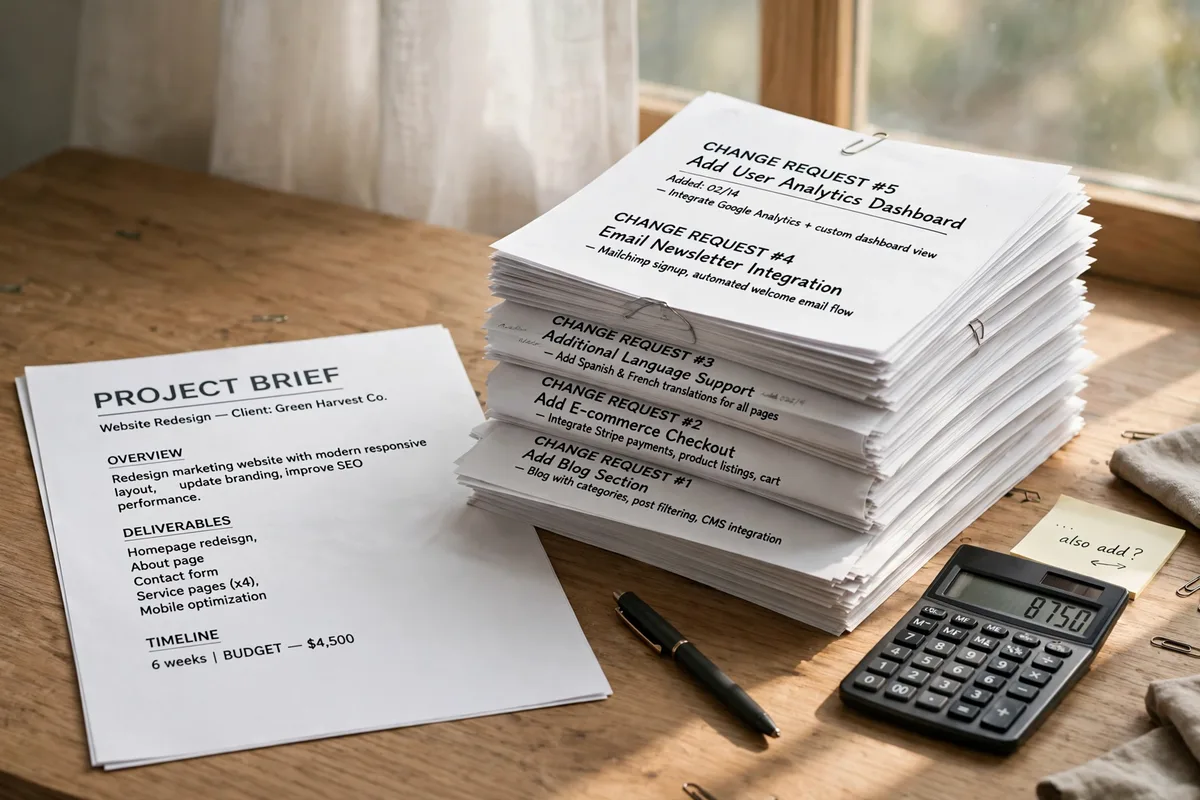
One extra revision is a favour. Five extra revisions is unpaid work.
The project was a logo, three concepts, two rounds of revisions, delivery by Friday. It is now Tuesday of the following week. The client has asked for a fourth concept, a version for a billboard nobody mentioned, and "just one more" round of revisions — the third "just one more" this week. You have not been paid a cent more than the original price, and you have not said a word about it, because bringing up money feels like the fastest way to lose the client.
This is scope creep, and it is the quietest way a freelancer works for free. It is not a late payment — the invoice has not even been sent yet, or it was sent for the original amount and paid on time. It is work that was never agreed, never priced, and never invoiced, growing a little at a time until the job you quoted bears no relation to the job you are doing. The fix is not a confrontation. It is a habit: every change goes in writing, with a price, before the work starts.
How to spot it before it eats the job
Scope creep rarely arrives as a big demand. It arrives as small, reasonable-sounding requests, each one easy to say yes to. Watch for these five:
- "While you're at it…" The client adds a task that was never in the brief — a second format, an extra page, a social version, a rush delivery. The phrase sounds casual. The work is not.
- The revision count quietly grows. Two rounds were agreed. You are on round four, and nobody has mentioned a limit since the contract was signed.
- The goalposts move. The deliverable changes mid-project: a different audience, a different platform, a different definition of "done." Each change is small; together they rebuild the job.
- New people appear with new opinions. The person who hired you approved the work. Now their boss, their partner, or a committee has notes — and each set of notes is a new round of work.
- "Can you just…" The most expensive two words in freelancing. "Just" makes the request sound like five minutes. It is almost never five minutes, and the minutes add up to hours you cannot bill.
One of these on its own is a normal project. Two or more, and you are no longer doing the job you quoted — you are donating the difference.
What it actually costs you
Do the arithmetic once, honestly, and the habit of saying yes gets much harder to keep. Take a fixed-price project as an example: you quoted $2,000 for a website, estimating 20 hours of work at $100 an hour. The client then adds three rounds of extra revisions and two new pages. That is, say, 6 extra hours. You have now worked 26 hours for $2,000 — your real rate is $77 an hour, not $100. That is a 23% pay cut you gave yourself, one "just one more" at a time.
The cost is not only money. Extra unpaid work pushes your other clients back, eats the evenings you had reserved for finding the next job, and leaves you resentful of a client you actually liked. Resentment is the real danger: it is what makes freelancers either explode at a good client over a small thing, or quietly deliver worse work. Charging for the extra work is not greedy. It is what keeps the relationship honest.
And the worst case is worth naming plainly. If you never raise it, the client does not learn that extra work costs extra — they learn that extra work is free, and they will bring that expectation to the next project, and the one after that. The client who gets five free revisions this time will ask for six next time. The price of silence compounds.
Step 1: define the scope before the work starts
Most scope creep is not a client problem. It is a contract problem: the scope was never written down tightly enough for either side to know when it ended. The single most valuable sentence you can add to your next agreement is a scope clause — a short paragraph that says what is included, and just as importantly, what is not.
A scope clause needs four things:
- The deliverables, named. Not "a website" but "a five-page website: home, about, services, contact, and one blog template, in the design approved on [date]."
- The revision limit, as a number. "Two rounds of revisions" means something. "Revisions until you're happy" means nothing — and it means the client decides when the job is done.
- What counts as a change. "Additional pages, new features, extra formats, and revisions beyond the agreed rounds are charged separately."
- The rate for extra work. Your hourly rate, or a flat fee per extra round. Put the number in the contract, so the conversation later is about applying a number you both already agreed — not inventing one under pressure.
If your contract has no scope clause yet, the payment clauses every freelance contract needs are the place to put it: deposit, due date, late fee, pause-work, kill fee, payment method — and scope, right beside them. A contract without a scope clause is a price for a job nobody has defined.
Step 2: every change goes in writing — the change order
Once the work has started, the rule is simple: no extra work begins until the change is written down, priced, and agreed. In project work this document is called a change order. It does not need to be formal. An email is enough, as long as it has these five lines:
- What is changing. "Add a sixth page (testimonials) and a second round of revisions beyond the two in the agreement."
- What it costs. "This adds $300 to the project fee."
- What it does to the deadline. "Delivery moves from Friday to the following Tuesday."
- What it does not change. "All other terms of the agreement stay the same."
- The client's agreement. "Please reply 'approved' and I will start on it."
Send it, wait for the reply, then start. That waiting is the whole discipline. The temptation is to start the work and send the email later, "so the client isn't kept waiting." The moment you do the work first, the price becomes a surprise — and surprises are what clients push back on. A price agreed before the work is a term. A price presented after the work is a complaint.
If the change is genuinely tiny — five minutes, no deadline impact — do it and note it in your next update: "I added the favicon at no charge; anything beyond this will be billed at the agreed rate." Free work you choose to give is a gift. Free work you drift into is a habit.
Step 3: how to say it — three levels of firmness
The words matter, because the fear is real: saying "that costs extra" feels like risking the relationship. It is not, if you say it early and plainly. Use the level that matches how far the creep has gone.
Level 1 — early, light, before the pattern sets in. For the first extra request, when the relationship is good and the ask is small:
Happy to do that — it's outside the original scope, so I'll add it as a small change order: $150, and delivery moves by one day. Shall I go ahead?
Short, warm, and it treats the charge as normal — because it is. Most clients say yes without a second thought, and the ones who do are the ones you want to keep.
Level 2 — firm, when the requests keep coming. For the second or third extra, or when the ask is large:
I can add that, and I want to be straight about the cost so there are no surprises: that's about four hours of work, so $400 on top of the project fee, and delivery moves to Thursday. If you'd rather keep the original scope and budget, I'm happy to do that instead — your call.
This version does two things the first does not: it names the hours, so the price feels earned rather than arbitrary, and it offers the original scope as a real alternative. The client is choosing, not being cornered.
Level 3 — the reset, when you are already deep in it. For the project that has already doubled and nobody has mentioned money:
I want to flag something before we go further. Since we started, the project has grown from five pages and two revision rounds to eight pages and five rounds — about ten extra hours so far. I should have raised this earlier, and that's on me. Going forward, I'd like us to agree the extra work to date at $1,000, and any further changes on the same basis, so I can keep giving this the time it deserves. Can we agree that before I start the next round?
Notice what this does not do: it does not blame the client, it does not apologise for charging, and it does not threaten to stop. It states facts, owns your part of the delay, and asks for agreement before the next round — not payment for work already done as a surprise bill.
One rule covers all three levels: never do the extra work and then invoice for it. The invoice is the last step, not the first mention. A client who agreed the price in advance pays it. A client who first hears about it on an invoice disputes it — and what to do when a client doesn't pay is a problem you do not need on top of this one.
Step 4: decide — accept it, price it, or decline it
Not every extra request should be billed, and not every one should be refused. Run each request through this table before you answer:
| The request | Your move |
|---|---|
| Small, quick, and the client is a good long-term one | Do it free, once — and say so: "On the house this time." |
| Small, but the third one this week | Price it. The pattern is the problem, not the size. |
| Large, or it moves the deadline | Change order, always. No exceptions. |
| It changes what "done" means | Stop and re-agree the scope before continuing. |
| You would resent doing it free | Price it. Resentment is the most expensive option. |
| The client cannot afford the extra | Offer a smaller version, or defer it to a second phase. Never shrink your rate silently. |
The last row matters. If the budget is genuinely tight, the honest answer is less work, not cheaper work. "I can do the testimonials page in phase two, after launch, for the same $300" keeps your rate intact and the client in control of their budget. Cutting your rate to keep a client teaches them your rate was negotiable — and it was not.
When the client refuses to pay extra
Sometimes you do everything right — the change order, the price agreed in advance — and the client still balks, or agrees and then does not pay the extra. Three things, in order:
- Pause the extra work, not the whole project. Finish what was originally agreed and paid for. The extra work waits until the extra payment arrives. This is what the pause-work clause in your contract is for — and it is far easier to use when the clause is already there.
- Offer the smaller version. "If the full extra is too much right now, I can do the testimonials page alone for $150 and leave the rest for later." A client who refuses the whole price often accepts half of it, and half is better than a standoff.
- Know when it is the relationship, not the money. A client who agrees a price, then refuses to pay it, has told you something important about how the rest of the project will go. Finish the agreed work, get paid for it, and think carefully before taking their next project. That is exactly the client how to vet a new client is written to catch before the work starts.
What you should not do is finish the extra work unpaid and hope the client notices. They will not notice. Unpaid work that is delivered on time reads, to the client, like work that was included all along.
Already deep in it? Reset mid-project
If you are reading this with a project that has already doubled and no change order in sight, it is not too late — but the reset has to happen before the next round of work, not after it. Use the Level 3 script above, in an email, not in a call: email leaves a record, and a record is what a reset is.
Then do two things immediately. First, write down the scope as it now stands — the real one, with everything that has been added — and get the client to confirm it in reply. That document becomes the new baseline: anything beyond it is a change order. Second, add the scope clause to your contract template tonight, while the lesson is still stinging. The next client gets the protection this one did not, and the deposit you ask for next time — see how to ask for a deposit — lands on a project whose size is actually defined.

Steal the exact words
Free sample: 3 late-payment email templates + the invoice checklist that gets invoices paid right the first time.
Want the whole system — all 12 templates, the contract clauses, late fee wording, and deposit scripts? That's The Get Paid Pack.
FAQ
Is it rude to charge for scope creep? No — and the clients worth keeping do not think so. You are not charging for being difficult; you are charging for hours. A client who expects unlimited revisions for a fixed price is asking you to work for free, and no professional in any other trade would accept that. The rude version is the surprise invoice. The polite version is the price agreed before the work starts.
What if my contract has no scope clause? Then this project runs on the change-order habit alone: every extra, in writing, priced, agreed before you start. And add a scope clause to your template before the next project — four lines (deliverables, revision limit, what counts as a change, the extra-work rate) prevent most of this from ever starting.
How do I price extra work — hourly or flat? Hourly is the honest default when the extra is open-ended, like more revision rounds. Flat is better when the extra is a defined thing, like one more page: quote the flat price, and if the client asks for more changes to that page, those are a new change order. Either way, name the number before the work, not after it.
The client says "just this once, and I'll make it up to you next time." Should I believe them? Treat it as a price, not a promise: "Happy to do it this once at no charge — I'll note it as a one-off so we're clear it isn't part of the scope." If the same request comes again, it is not "just this once" anymore, and the change order applies. Future work is not payment for present work.
What counts as scope creep, and what is just doing the job properly? Fixing your own mistake is not scope creep — if the work does not match what you agreed to deliver, fixing it is on you. Scope creep is work the client adds: new features, new formats, new audiences, new rounds. If you are unsure which one it is, ask: "Was this in the original brief?" If the honest answer is no, it is a change.
Steal the exact words
Free sample: 3 late-payment email templates + the invoice checklist that gets invoices paid right the first time.
Want the whole system — all 12 templates, the contract clauses, late fee wording, and deposit scripts? That's The Get Paid Pack.
Read next

6 Payment Clauses Every Freelance Contract Needs
Six clauses — deposit, due date, late fee, pause-work, kill fee, and payment method — with sample wording you can copy into your next contract.

What to Do When a Client Doesn't Pay: A Step-by-Step Escalation Guide for Freelancers
A step-by-step escalation ladder for when reminders stop working — from a friendly nudge to a final demand letter and beyond.

How to Vet a New Client Before You Start Work
Most late payments are decided before the work starts — five red flags, the checks that take minutes, and the protections to insist on when you say yes anyway.